
TIP tip of the month: Read the tip.announce newsgroup regularly for important messages regarding The Internet Project. Also, the tip.general newsgroup is a forum for discussion of many of the issues relating to TIP and the wider Internet plus a source of many interesting proclamations, declarations, arguments, flames and spams.
Merry Christmas everyone out there in TIP-land! Due to deadlines common in publishing, I wrote last month's article proclaiming the success of the relocation and upgrade of TIP some weeks before the actual event. This lead to some sleepless nights leading up to the weekend of 16 November, hoping that I would not look like more of an idiot than I am. Well, as most of you probably realise, future history bore out my story. TIP has successfully relocated to new premises in the back room of the PCUG Centre at Belconnen, and now that the dust has settled, the truth can be revealed...
It all began some months ago, when Karl, I and the rest of the IPMC decided that we (or more specifically you) could do with a few more modem lines. A new product announcement from Cisco aroused our interest with promises of up to 60 in-dial lines on just two physical connections (which meant there would be no more messy cables), but also provided true digital connectivity (better quality, more reliability), full manageability of the modems (no more trips out to reset dud ones), and a smaller 'footprint' (less size = less space, power, noise and heat).
Specifications were scanned, costing was done, and talks were held with Cisco. We decided to go for it. Fortunately (unfortunately?) the PCUG were moving to new fancy premises at about the right time, and we thought 'Hey, why not kill two birds with one stone?' It was easier to have Telstra supply two ISDN lines from Day One at the new centre than have some 60 individual phone lines put in, and then removed at a later date. Then the hard work began.
First step: gaining Committee approval. Budgets and specifications were produced. Much discussion took place. In fact the AS5200 was, and still is, responsible for generating a HUGE amount of committee email; enough to elicit groans of despair from everybody when downloading their mail and to drive people screaming from the committee. The motion was passed with as little pain as a kidney stone. During this, negotiations with Cisco and Telstra regarding pricing were under way, and finally we were able to place orders and begin planning.
The first major hurdle encountered was delivery of the AS5200. As a 'hot new product', demand far exceeded supply. Our thanks go to Peter Elford, Mark Hales, and Deanna O'Brien of Cisco (and apparently the ACT Branch Manager, Phil Hollely, and the Australian Country Manager, Scott Ferguson) for their efforts in getting a unit to us with enough time to set up before cutover. With the cutover date rapidly approaching, we began calling for volunteers, mapping out strategies for moving, and delegating tasks.
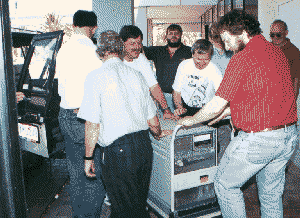 Friday 14th. Oh dear (or words to that effect), our outbound ISDN link isn't installed. A quick phone call to Telstra produced a tech. at 6pm that night to install it. Thanks, Karl!
Saturday morning, 9am. There are still 30 people connected. We are on a schedule, so they aren't on for long. The power is dropped and frantic work begins disassembling racks, removing modems, untangling cables, sorting into piles. At this time I am calmly enjoying a coffee at Belconnen.
The first load arrives at its new home at about 10:45am, along with all the other loads. And I thought that the deliveries would be staggered to simplify reconstruction. Ha.
Friday 14th. Oh dear (or words to that effect), our outbound ISDN link isn't installed. A quick phone call to Telstra produced a tech. at 6pm that night to install it. Thanks, Karl!
Saturday morning, 9am. There are still 30 people connected. We are on a schedule, so they aren't on for long. The power is dropped and frantic work begins disassembling racks, removing modems, untangling cables, sorting into piles. At this time I am calmly enjoying a coffee at Belconnen.
The first load arrives at its new home at about 10:45am, along with all the other loads. And I thought that the deliveries would be staggered to simplify reconstruction. Ha.
My second vote of thanks (speaking as the one who was supposed to have all the routers and modems going as quickly as possible) goes to Fred Steele who managed to calmly recable what seemed like the entire Communications room. Fred spent practically the whole day working quietly and efficiently (and even returned quite a few times during the week to help fix the problems, but more on that later). Thanks must also go to Michael Lightfoot and his children who spent some time restoring the shelves into the rack after I diligently removed them. (Hey, I didn't think that we'd need them any more!) Our UNIX gurus quickly had supreme and cheese operating again, and at around 7.30pm the ISDN lines were activated to allow calls. Within minutes we had a dozen or so people connected. (How did you know, or was it just a lucky guess?) We had executed the entire move in less than 7 hours. Whoo-hoo! But... at around 10am on the next day, the first call came in. Only one of the ISDN lines was functioning which meant that we were operating at half capacity. Subsequent phone calls indicated that those who could get on were being dumped after only short periods of time. It took less than 24 hours for the system to practically grind to a halt.
After some testing and checking, I decided that it must have been a Telstra fault. I reported it that evening, and then left for a two-day course in Melbourne.
But no, Telstra could find no fault. Karl and Fred did some testing on Monday night but still could not isolate the problem. Okay, it must be a fault in the Cisco equipment. Cisco were getting ready to ship us a replacement when, on Wednesday lunch time, Fred (who had returned to help a Telstra tech track down the fault) somehow managed to discover a faulty patch cable between the ISDN line and the Cisco router. This replaced, the system became fully operational again. Whew!
Since then, we are recording 95% successful connections, and anecdotal evidence suggests that people with the right modems are getting 28800 bit/s connections every time - something that hardly ever happened with the old analog system. Here's cheers to a successful project!
Lets hope nothing else happens now before this goes to press...
We estimate that approximately 400 accounts will be removed. This will also convert a portion of money allocated as 'unused' hours into income, and reduce our liability in this area. Note that as per both the old and the new Acceptable Use Policy, TIP fees are non-refundable.
If you fall into one of the above categories, and you wish to retain your TIP account, then we suggest that you take steps to rectify the problem. If you no longer require your account, then please notify us.
This notice will not be published via email or newsgroups, as the people that it is directed to do not have access to that medium anyway.
The next step from there is to increase the size of our 'pipe' into the rest of the Internet. Our contract with our current supplier (Access One) expires early in the new year, and we are going to take the opportunity to improve our link capacity. As you know, we are currently operating on a link that is 128 kbits/s in size. We are currently negotiating with suppliers to obtain the best price for a link double that (256 kbits/s).
Unfortunately, we are discovering that the playing field is very corrugated. The PCUG committee has come to the conclusion that in order to increase the link capacity, with an eye to possible future upgrades, whilst still maintaining group reserves, it will be necessary to increase the annual TIP charge.
As of 1 February 1997, the cost of Advanced Access to The Internet Project will rise to $120. This will still provide for up to 300 'TIP hours' during that period, and works out at 40c per hour - still the cheapest around.
This decision was not taken lightly, but was the subject of much soul-searching and in the end it was concluded that you, the users, would understand and appreciate this decision in the knowledge that the service will be significantly improved.
Please contact either myself or the PCUG Committee regarding any of the matters above if you have any comments or questions.
To conclude on a lighter note, here is a festive riddle:
Q. Why do computer programmers get Halloween & Christmas confused?
A. OCT 31 = DEC 25
 Back to Index